Installing a ceiling dehumidifier, end to end.
A real install rarely matches the brochure. Here is what actually happens between the site survey and the moment the unit holds 55% RH — written from the ceiling void down.
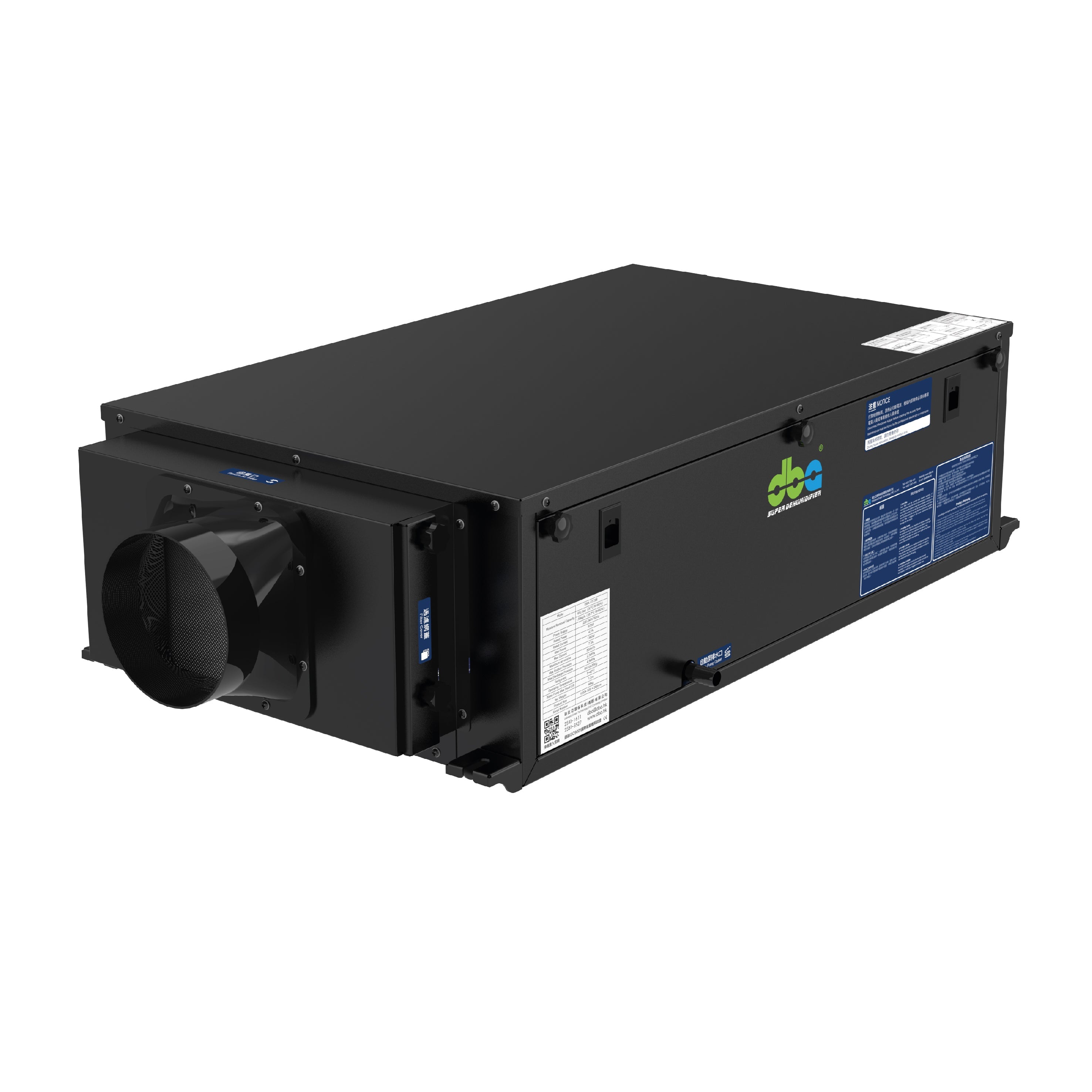
Most ceiling dehumidifier failures we are called in to fix are not product problems. They are site problems — a duct run that is twice as long as the brochure assumed, a condensate drop that runs uphill, a sensor mounted next to a fresh-air grille, an isolator switch that nobody can find. The unit itself usually performs fine once the install around it is sorted out. So here is a practical pass through the install sequence as we run it on a typical Singapore residential or light-commercial job.
1. The survey: ceiling void first, everything else second
Before anyone quotes a model, someone has to push a ceiling tile aside and look. Ultra-slim ceiling dehumidifiers like the DBA-UTC range need around 240–310 mm of plenum depth depending on capacity. Commercial GEC units need more. If the void is shallower than the unit, no clever spec will rescue the project.
While you are up there, you are also looking for the four things that decide where the unit physically lives:
- A structural ceiling joist or RC slab capable of carrying 28–70 kg of unit plus the weight of the trapped water
- A clear path for the return-air grille without conflicting with downlights or fire sprinklers
- A drainage destination — floor trap, FCU drain, balcony outlet — that the condensate pump can actually reach
- A 220–240 V supply nearby, or a route to bring one in without surface trunking
Survey everything before you commit to a unit. We have replaced a 145 L/day commercial unit with a smaller model purely because the ceiling void changed by 40 mm between the architect's drawings and the as-built.
2. Choosing the unit and its location
For sizing, see our sizing guide. For where to physically place it, three rules:
- Centre of the served zone. Dry air should travel toward the wettest part of the room, not away from it. A unit in the entry foyer rarely fixes a bedroom problem on the other end of the apartment.
- Away from the return-air conflict. If you are sharing a ceiling void with an FCU, keep the dehumidifier's return at least 1 m from the FCU's return, or you will create a short-circuit and dry only the air right beside the unit.
- Reachable by maintenance. The filter behind the return grille needs cleaning every 6–8 weeks in Singapore. If you have to lift two layers of plasterboard to get there, you are designing for failure.

3. Mounting and vibration isolation
Suspend the unit from threaded rod (M8 minimum for UTC, M10 for GEC) anchored to a structural element — not to the plasterboard frame. Use neoprene or spring-mounted vibration isolators between the unit and the rod. A 28 kg compressor unit running 18 hours a day will telegraph straight into the ceiling below if it is hard-mounted, and the only practical fix at that point is to drop the entire ceiling and start again.
Leave a 50–100 mm air gap on all sides for service access. Cold-rolled steel casings handle being knocked once, not repeatedly.
4. Drainage
Every single-phase ceiling dehumidifier in the DBA range — UTC and the single-phase GEC commercial units (GEC68LD-HP, GEC145LD-HP) — ships with an integrated 1.8 m pump. A check valve is built into the supplied drain hose, so back-flow protection is handled by the unit itself. The correct routing is to rise from the unit to a high point at the top of the pump's reach, then fall by gravity from that high point to the discharge — using the full 1.8 m lift and letting gravity carry the rest.
Three-phase ceiling units (GEC280LD and above) drain by gravity only — no pump. The line must slope continuously downward from the unit to the discharge with no rising section.
See our deeper guide on drainage routing for the full method and commissioning checks.
5. Power and isolator
UTC and GEC68/145 run on standard single-phase 220–240 V 50 Hz. Larger GEC280 and above need three-phase 380 V. A dedicated 16 A or 20 A circuit is correct — never share a circuit with lighting or an FCU. Fit an isolator within sight of the unit so a maintenance technician can drop power without climbing back into the void.
If the unit has an emergency-stop input or a water-leak port (most DBA ceiling units do), wire them now. They are five minutes during install and impossible to retrofit cleanly later.
6. Ducting
Two paths exist:
- Free-blowing through a single supply grille beside the unit. Works for compact spaces and small UTC capacities.
- Ducted through one or more flexible or rigid ducts to grilles in different zones. Required for any installation serving more than one room.
The key constraint is external static pressure. UTC units handle around 30 Pa; GEC pushes higher. Every duct metre, bend, and grille adds pressure loss. Run the numbers before you specify, and read our ducting guide for the calculation.
Field note
If you are taping flexible duct, use proper foil tape — not gaffer tape. Singapore plenums hit 35°C in mid-afternoon, and standard cloth tape fails inside a year. We have lost count of how many "leaking unit" callouts turned out to be a separated duct above the ceiling.
7. The humidity sensor
Most ceiling dehumidifiers ship with a remote humidity sensor on a 5 m cable. Where you mount it decides what the unit thinks the room feels like.
- Mount the sensor at 1.5 m height on an interior wall, in the occupied zone
- At least 1 m from any door, window, or air outlet
- Out of direct sunlight
- Not behind furniture, curtains, or in a built-in cabinet
Many "the dehumidifier never turns off" tickets are sensors mounted next to a bathroom door, picking up shower humidity for hours after the actual room has dried. Move the sensor; close the ticket.
8. Controls and BMS
DBA's UTC, GEC, and HC ranges all expose an RS485 Modbus port plus dry-contact outputs. Smaller models also offer WiFi App control. Decide before commissioning who owns the setpoint — the user via remote, the BMS, or a scheduled program. Two systems fighting over the same setpoint is a guaranteed support ticket.
9. Commissioning
Once the unit is mounted, ducted, drained, and powered:
- Run the unit in dehumidify mode at setpoint 45% RH for 30 minutes. Confirm condensate flow at the drain destination — actually look at the outlet, do not just listen for the pump.
- Measure airflow at every supply grille with an anemometer. Compare against the design CMH per zone; rebalance dampers if needed.
- Walk the served zones with a hand-held hygrometer and confirm the sensor reading matches within ±3% RH.
- Cycle the emergency stop and the water-leak port to confirm they actually shut the unit down.
- Hand over the BMS / WiFi App credentials, and label the isolator and ceiling access panel.
10. The first month
Singapore moisture loads spike during the wet monsoon, and a unit that looks oversized in dry season can fall just behind in November. Set up a calendar reminder to revisit the setpoint and runtime after the first 30 days, and walk the ceiling void once for any sign of drain leak — a wet patch on a ceiling tile is much easier to fix when it is still small.
If you would like a project surveyed — residential or commercial — we run the survey, supply the unit, and commission the install as a single line. Send us the floor plan and we will come back within a business day.
Get help with your project
Get a ceiling dehumidifier specified properly.
Tell us the floor area, the ceiling void depth, and the moisture concern. We will recommend the right DBA model and walk you through the install.
Request a quote